Samsung Galaxy Z Fold 8 Ultra Review

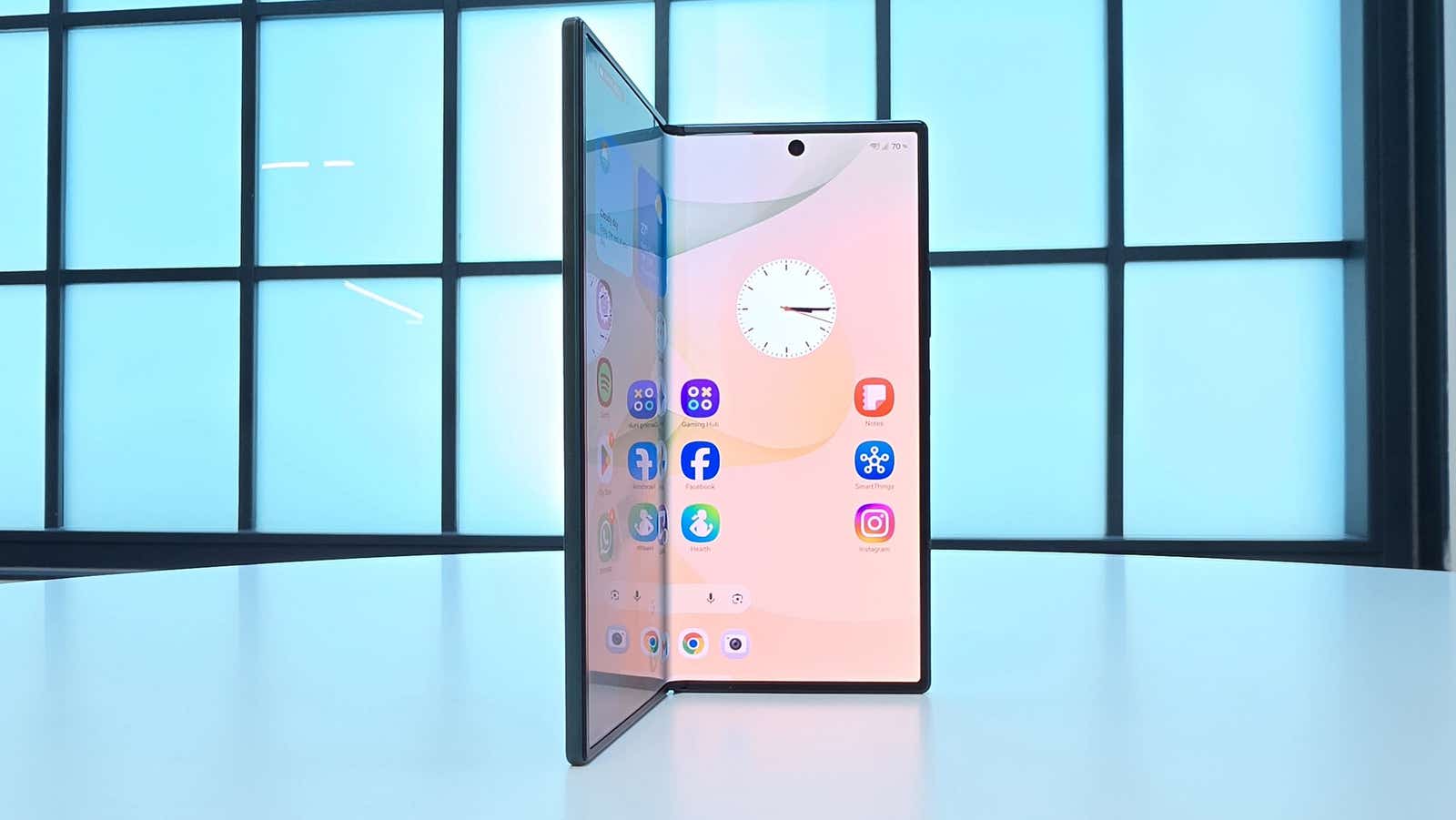
Samsung Galaxy Z Fold 8 Ultra pros and cons
Slimmed-down foldable form, measuring just 4.1mm when open.
5,000mAh silicon-carbon battery beefs up lifespan.
Huge camera overhaul, including 200-megapixel main sensor and 50-megapixel ultra-wide.
3,000-nit peak brightness across both displays, sporting an improved anti-reflective finish.
High starting price of £1,899.
IP resistance ratings against dust and water lag behind competition.
What makes a phone ‘ultra’?
We’ve been collectively grappling with how to coin that definition for the better part of two decades, but Samsung has decided to bestow the title on the slightly less exciting - but more impressive on paper - of its 2026 foldable devices.
The Samsung Galaxy Z Fold 8 Ultra seems to earn the name by perfecting the traditional tall silhouette with dramatically refined hardware from camera to battery, delivering a foldable device that operates on top form.
This deliberate design distinction over the compact Z Fold 8 (reviewed here) sees the Ultra cater exclusively to those demanding maximum screen real estate alongside absolute top-tier specs…albeit with a price tag to match.
Just how much can this upgraded device power up your portable productivity?
Read on for our in-depth Samsung Galaxy Z Fold 8 Ultra review.

Design and specifications
The look and feel of the Galaxy Z Fold 8 Ultra immediately illustrate a conscious effort from Samsung to level up their latest foldable in every physical dimension - a comprehensive set of textbook refinements serve up a truly premium handset.
It starts from the general aesthetic - a trio of sophisticated colourways in Graphite, Cream, and Violet Shadow all lend a distinguished air to the device with a subtle matte finish perfect for better rear grip and reduced fingerprints in equal measure.
Those seeking something even more exclusive can find a Green Shadow variant - reviewed here - available directly from the manufacturer.
This hue stands out in particular, evoking the dusky racing green found on many a classic car and exuding that Samsung flair.
Slender, squared-off corners and an impossibly thin profile - just 8.9mm thick when closed - result in a phone which belies its ability to fold at all and marks a measurable improvement on the Fold 7’s (relatively) bulky 12.1mm.
The dimensions of a highly manageable 158.4 mm in height and 72.8 mm in width once again lend it a taller frame more in keeping with traditional smartphone measurements, and ideal for everyday use.

Naturally, opening the handset is where it truly wows, exposing an expansive tablet footprint spanning a width of a whopping 143.2 mm, and a breathtakingly thin depth of just 4.1 mm - yet another device where the need for a USB-C port seems like the only physical barrier to an even more razor-thin profile.
All this also comes with a meaningful weight reduction, down to a svelte 215g - with the Z Fold 8 Ultra besting almost all competition (aside from its own sibling in the Fold 8’s remarkable 201g) in a tale of the scales.
Honor’s Magic V6 was the one to beat at just 219g in its most featherweight incarnation, and the Fold 8 Ultra makes Motorola’s Razr Fold, Google’s shiny new Pixel 11 Fold and last year's Z Fold 7 seem positively portly in comparison at 243g, and the latter two matched at 239g respectively.
Rather than being just an academic win, this weight difference does genuinely make the Fold 8 Ultra’s daily use a cut above when it comes to simple portability - to have so much foldable functionality brought to bear in such a light device is a real engineering feat for Samsung’s finest.

On the topic of engineering, Samsung has naturally made a lot of noise around improvements to the all-important hinge, where a lot of grams have been shed due to the adoption of ‘Flex Titanium’ technology.
The product of seven years of research and multiple foldable iterations, a new FlexHinge mechanism benefits from magnetic technology drawn from Samsung's brief foray into a triple-screen foldable with their limited Z Trifold device, delivering a smoother and more secure closure than the Fold 7, and almost zero points of ingress when shut.
This structural integrity is reinforced by an aluminium frame and Corning Gorilla Glass Ceramic 3 on the front display, providing exceptional resilience against daily wear and tear - although admittedly not a match for my wife’s cavernous purse and a set of keys.
The Fold 8 Ultra’s matte rear glass panel is protected by Gorilla Glass Victus 2, and the handset carries a decent IP48 certification for water and particle protection.
This lends some peace of mind for robust use, but stops short of the hardiness offered by the latest Chinese efforts, with both Oppo’s Find N6 and Honor’s Magic V6 having levelled up to IP58/59 and IP68/69 ratings, meaning fine dust resistance and prolonged water immersion is no trouble for others, but still a bridge too far for Samsung’s latest...

Not content with taking titanium to the hinge alone, the Fold 8 Ultra’s inner display incorporates a thin alloy film layer - lending both rigidity and a noticeably flatter and more uniform display surface - a lot of words to say that the crease is much shallower.
So improvements abound with the Z Fold 8 Ultra’s titanium display credentials, yet the shadow of competition looms large.
Oppo’s incredible ‘zero-feel’ crease remains the gold standard when it comes to a truly near-imperceptible inner display ridge, but Samsung’s innovations have really narrowed the gap - no pun intended.
Returning to the rear, the vertical layout of Samsung’s camera design language persists on the Fold 8 Ultra, where a set of three lenses are housed in a uniform oval on the top-left of the device, with the flash outside of it.
This does make for a phone which has a distinct wobble on a flat surface, countered when laid out in a ‘laptop’ format, but does mean the need to place the cover screen face down on the table in this scenario.

Physical buttons are limited to a slender set of keys on the right side of the device - a tiny volume rocker housed in a single button, and the power button just above the centre.
The latter pulls double-duty as a fingerprint sensor - an impressive improvement is the rapid registration of digits without removing your finger, and between this and the facial recognition on the centrally-housed selfie camera means more than enough by way of security, bolstered by Samsung’s Knox suite.
When it comes to the battery, the adoption of silicon-carbon technology has seen a bump in specs to a 5,000mAh battery, resulting in around 7 hours of screen time at a push, and 45W wired charging - a material improvement on the Fold 7’s 4,400 mAh, but does trail the premium foldable pack in both endurance and speed when - yet again - the Find N6 and Magic V6 are touting 6,000 mAh and 6,660 mAh with 80W charging.
The question of whether the weight vs. battery life trade-off has been worth it will continue to rage, but on balance - and considering this is Samsung’s initial introduction into this newer technology - it’s one area where we hope to see them close more daylight in future.
Chipset is no slouch as Snapdragon’s custom-built for Galaxy 8 Elite Gen 5 powers the Fold 8 Ultra - matching both its boxy brethren in the Fold 8 and current competition - with some overclocking for good measure to see it stretch ahead.
Married to an octa-core CPU and an Adreno 840 GPU, there’s more than enough power for Samsung’s Galaxy AI functionality, gaming and professional multitasking alike - so it’s clearly one aspect where there haven’t been any compromises made to deliver.
In summary, this refined final form of the familiar foldable layout in the Fold 8 Ultra is top of the table when it comes to the combination of build quality and aesthetic flair, resulting in a robust, professional device that cements its ultra status in the Z series lineup.
There are still areas for improvement in terms of display crease, battery life, and IP ratings that mean competition will keep the Korean manufacturer on its toes - but we know it’s more than mere hardware that keeps consumers flocking to Samsung.
Display and audio

Samsung doesn’t miss when it comes to display hardware - so whilst the Fold 8 Ultra matches both the Fold 7’s 6.5-inch cover panel and 8-inch inner efforts in terms of size, there are still substantial upgrades to observe.
The external screen’s taller 21:9 aspect ratio is perfectly serviceable in its own right for daily use, acting as a brilliant triage centre for notifications and quick replies.
It features an FHD+ Dynamic LTPO AMOLED 2X panel with a resolution of 2520 x 1080 pixels and a highly crisp ~422 PPI density.
Protected by tough Corning Gorilla Glass Ceramic 3, this cover screen offers peace of mind against accidental scratches while remaining incredibly responsive, but whether it stands up to the slings and arrows of being battered about is down to the individual.
Brightness and clarity have taken a massive leap forward across the entire device. Between a phenomenal step up in peak luminance to 3,000 nits versus the prior model’s 2,600 nits and a brand new anti-reflective coating, the Fold 8 Ultra is even more legible in harsh outdoor settings through essential glare reduction.
This sheer brightness is paired with an intelligent Vision Booster algorithm, ensuring that reading emails or framing photographs in direct sunlight is entirely effortless.
Both displays support a dynamic variable refresh rate scaling seamlessly from 1Hz up to a silky, stutter-free 120Hz for fluid interactions, as well as preserving crucial battery life when viewing static content.

Unfolding the ultra-thin frame reveals an expansive QXGA+ Dynamic LTPO AMOLED 2X main screen.
This glorious 8.0-inch canvas boasts an increased resolution of 2504 x 2256 pixels and increased pixel density of 422 PPI, besting the Fold 7’s 368 PPI.
The integration of HDR10+ support guarantees that streaming content - when compatible - pops with spectacular contrast, delivering deep, inky blacks and blistering highlights.
We might be splitting hairs a bit here in terms of actual noticeable improvements to everyday clarity, but in reality, that ability to reduce both font size and screen zoom - a genuine boon for lovers of tiny text - makes multi-window multitasking feel considerably less cramped on the Fold 8 Ultra.
Three heavy productivity applications can be run simultaneously - two side-by-side with a third as a tile - or use the expansive screen to navigate while retaining crispness across every window.
That new Flex Titanium structure breaks cover here to reduce that central display crease and minimise distraction both when viewing content and running a finger across the ridge. It’s still very much visible and does increase a little over the few weeks of testing that we’ve put in, but it’s far less perceptible than previous models.
It’s also not made of the same material as the exterior display - inherent to giving it that foldable nature - so it does need a decent amount of care when poking at prodding the inner canvas with nails.
For those looking to use a stylus as an alternative, unfortunately that functionality has been officially lost in Samsung’s pursuit of slimline smartphone perfection, but third party accessories can bring back some of the fine control sought.

When it comes to audio, the acoustic performance of the Fold 8 Ultra not only refines the polished media experience seen (and heard) on the Fold 7, but also offers a distinct advantage over the standard Fold 8.
Because the Ultra retains the traditional book-style foldable orientation, rotating the handset 90 degrees for landscape video playback positions the stereo speakers squarely on the left and right sides of the frame, as opposed to the novel situation of the Fold 8 staying in portrait and resulting in an imbalanced output, with both speakers staying on the left.
This orientation delivers brilliant stereo separation and a genuinely immersive soundscape for films and games, ensuring that the spectacular visual display is matched by equally capable audio projection.
It’s also the case that solely using the cover screen in landscape offers both a luxurious 21:9 ratio and the sound separation due to the speakers flanking the display in a symmetrical central orientation.
The speaker enclosures themselves have been expertly tuned, offering punchy mid-range frequencies and a surprising amount of bass depth for such a slim chassis.
Testing the hardware through an eclectic library showcases the strengths - and limits - of these diminutive drivers.
Firing up the cacophony of distorted bass kicks and hyperactive production of 100 gecs pushes the speakers to their absolute limit, yet they manage to hold the low-end together with admirable heft and minimal distortion at higher volume.
Switching gears to the airy, drum-and-bass-tinged vocals of PinkPantheress’ viral hit ‘Break It Off’ reveals crisp treble response and clear vocal separation that cuts effortlessly through rapid breakbeats.
On the technical side, the Fold 8 Ultra arrives with comprehensive audio standard support, including Dolby Atmos virtual surround sound, high-bitrate audio playback, and high-fidelity wireless streaming via both aptX and aptX-HD codecs.
As for the perennial question of the 3.5mm headphone jack, it predictably remains absent here.
While wired purists will mourn its continued omission, the Fold 8 Ultra compensates with top-tier connectivity through a high-speed USB-C port, while wireless duties are backed by Bluetooth 6.0 and Wi-Fi 7, ensuring rock-solid, low-latency audio output whether pairing high-end over-ear cans or a set of compact wireless earbuds.
So a pretty formidable content consumption device, whether open or closed - the Fold 8 Ultra certainly makes a strong case for acting as a mini-cinema in your pocket.
Camera capabilities

The camera array on the Galaxy Z Fold 8 Ultra represents a dramatic overhaul to Samsung's foldable photography credentials, addressing historical hardware compromises while also delivering material improvements over the Fold 7.
Whilst the previous generation relied on a standard 50-megapixel primary camera and modest 12-megapixel ultra-wide, the Fold 8 Ultra equips a setup that genuinely rivals Samsung’s top-tier Galaxy flagships.
A 200-megapixel primary wide-angle sensor is the unmitigated focal point, with an f/1.7 aperture crafting a lens that captures breathtaking detail and vibrant colours across a multitude of lighting conditions.
The sheer resolution available permits heavy cropping into photographs after shooting without suffering noticeable degradation in clarity, despite the camera defaulting to a pixel-binned 12-megapixel output for everyday snaps.

In addition, Samsung has introduced an advanced High Dynamic Range capability operating directly within that full 200-megapixel mode.
This ensures ultra-high-resolution shots benefit from balanced exposures, retaining highlights and detail alike while simultaneously lifting shadows for true-to-life images.
For creative professionals seeking granular control over ISO, shutter speed, and multi-frame capture, Samsung's dedicated Expert RAW application remains just a quick download away via the Galaxy Store, integrating directly into the default camera viewfinder settings via a shortcut once installed.
The below shots of our monstrous sunflower in the garden show the level of close-up detail that can be brought to bear in this mode, with the telephoto serving incredible distinctness and colour accuracy in equal measure.


Sitting alongside the primary snapper is a heavily upgraded 50-megapixel ultra-wide camera with an f/1.9 aperture, a significant leap over the 12-megapixel sensor on found in the Fold 7.
The extra pixels bring edge-to-edge sharpness to wider vistas, making it a triumph for sweeping landscape photography and architectural shots.
This versatile lens also doubles as a capable macro shooter, enabling the camera to be brought close to a subject to capture fine texture.
Getting shots of both the Fenchurch Building and capturing fast-moving lifeboats on the water during Penzance's annual Water Safety Day made for exciting shots of both static architecture and a swift showcase of the great work of the emergency services.


The Fold 8 Ultra retains its dedicated 10-megapixel telephoto lens with an f/2.4 aperture offering true 3x optical zoom capabilities, delivering crisp portrait shots with natural background blur that software processing cannot replicate.
Samsung has paired this upgraded hardware with its next-generation ProVisual Engine, dedicated entirely to powering the brand's night-mode features.
The bespoke processing significantly enhances low-light photography, working in the background to ensure nighttime shots remain bright, well-exposed, and free from digital noise - with decent results on the whole.


The massive 8-inch internal display can also act as a tablet-sized viewfinder, providing a great - if somewhat more unwieldy - window in which to find the perfect composition.
Engaging Flex Mode allows the device to be folded partially and rested on any flat surface, transforming the phone into its own tripod for stable, hands-free long exposures or time-lapse videos.
Detailed selfies can also be captured using the primary 200-megapixel rear camera by opening the device and previewing the shot on the 6.5-inch cover screen - although the front-facing 10-megapixel effort housed within the display is equally effective.


Check out the latest Samsung Galaxy deals on Uswitch

For videographers, the Galaxy Z Fold 8 Ultra delivers recording options that completely eclipse the Fold 7.
The camera system supports up to full 8K resolution shooting at 30 frames per second and 4K at 60 frames per second, meaning that moving content is as lush and crisp as one might expect.
Content creators will appreciate the inclusion of Cine LUT technology, which offers four preset cinema styles directly within the camera application to apply professional colour grading in real time.
The Fold 8 Ultra also supports the open-source APV codec for advanced post-production workflows, while optical image stabilisation ensures smooth footage during handheld walking shots.
Those dual 10-megapixel selfie cameras embedded in both displays are equally as effective for crisp video calls.
When placed alongside the wider foldable market, the camera array on the Galaxy Z Fold 8 Ultra is a real technical showcase of foldables delivering high-quality imagery without compromise in quality or form factor.


While Google's latest Pixel foldable seems set to deliver decent point-and-shoot software processing and Honor - as well as Motorola’s Razr Fold proving a welcome surprise - continues to push the boundaries, few currently match the sheer power and dynamic range of Samsung's 200-megapixel primary sensor.
Even in its own class, Samsung standard Galaxy Z Fold 8 completely omits a dedicated optical zoom lens to maintain its highly compact footprint.
By both retaining a true 3x optical telephoto lens and introducing professional-grade recording formats, the Fold 8 Ultra successfully narrows the gap between folding phones and traditional flagships.
In the round, it's the most capable and versatile camera system currently on any foldable, and a commendable step forward for the category.

Performance and software
Powering the Fold 8 Ultra is the custom-built Snapdragon 8 Elite Gen 5 processor for Galaxy, manufactured on an advanced 3nm process.
This results in enhanced graphical rendering, and vastly improved thermal management via an expanded graphite cooling structure.
In reality, this meant silky performance on custom settings for Genshin Impact and Infinity Nikki on that huge inner screen, as well as managing complex multi-window tasks with barely the occasional stutter.
Samsung's own stable of bite-sized games also work via its Gaming Hub, offering both native and streaming experiences across a number of popular titles, such as Asphalt Legends (below).
The software experience is another area where Samsung remains head-and-shoulders over competition, with their One UI 9.0 layering smooth - foldable-centric functionlaity throughout Google's latest Android 17 operating system, with some meaningful steps toward agentic AI experiences - a suite of tools operating and actively performing tasks on one's behalf as opposed to solely offering solutions.
At the heart of this innovation is Now Nudge, a system offering split-screen integration of context-sensitive moments.
For example, if you are arranging a plan to meet in a chat app, the software can automatically surface the calendar alongside the message thread, and suggest a reminder or meeting invitation.
This system weaves its way through calendar, location and emails alikes, lending subtle ambient and notification nudges and contextual cues to try and streamline common activities - however a lot of that functionality seems to work best within Samsung’s own universe of apps and services.

Despite Samsung’s claims of deep integration with third-party messaging apps and software, its presence was notably a little more limited when using the likes of Whatsapp, Google Messages, Keep and even Gboard as a default keyboard app over Samsung’s own - it’s important to note that the ecosystem flourishes most when the user remains firmly within it.
The operating system can perform these agentic actions across multiple distinct applications, using the Gemini assistant to open apps and perform actions on your behalf, leveraging contextual details directly from the screen.
It's truly impressive when it happens, and together with a commitment to seven years of major OS updates, these software enhancements turn the expansive canvas of the Fold 8 Ultra into a portable powerhouse of productivity.
Battery life and charging
Powering a massive foldable display while maintaining an ultra-thin profile requires a feat of modern engineering, and the Galaxy Z Fold 8 Ultra delivers impressive endurance with an increase to a 5,000mAh battery - another upgrade over the Fold 7's 4,400mAh.
Swapping out traditional graphite, Samsung has adopted the popular silicon-carbon battery technology resulting in significantly higher energy density, and debuting in this range of foldable devices.
The net result in a massive boost to portable power without adding unwanted heft to the flagship form factor.
Real world measurements matched up to the specs sheets, with the Fold 8 Ultra delivering a full day of work - and play - as a daily driver, with commute of music, multitasking and camera images seeing the device at around 25% of an evening.
It's still a far cry from the monstrious batteries found in the current generation of competition from Chinese phone makers - the Magic V6's ominous 6,660mAh battery springs to mind- but the combination of internal efficiency thanks to Snapdragon 8 Elite Gen 5 processor and a pair of dynamic LTPO displays scaling down to a 1Hz refresh rate, ensures that power drain remains steady and predictable.
This remains true even when juggling three active windows or connecting to an external monitor via Samsung DeX - effectively turning the device into a mini-computer complete with taskbar and multiple window support.

This fancy new technology does have its drawbacks however, mainly in the form of a shorter overall battery lifespan versus traditional batteries.
While silicon-carbon allows for a greater capacity in a thinner body, the number of cycles sits at around 1,000 charging cycles, compared to the 1,500-plus lithium-ion smartphone batteries.
Nonetheless, this still represents over three years of daily full charges before noticing any sort of dips in capacity, providing plenty of reassurance for long-term ownership - with Samsung's Care programme also providing warranted back-up for servicing and support.
Actual charging is another area of improvement - where an offiical adapter can provide 45W rapid charging to 67% from flat in half an hour.
Given the array of different plugs and chargers around homes and offices across the land, the reality is that Samsung's devices can take a while, routinely looking more like 45 minutes to an hour to charge.
The Fold 8 Ultra does also accommodate 20W fast wireless charging for convenient top-ups on compatible desk pads, making it easy to keep power levels high throughout the working day, as well as reverse-charging support for other accessories when caught short.
So whilst the increases to battery capacity and charging speed are massive plus points for Samsung's finest, the sheer capacity and speeds from rivals does mean there's still daylight against the competition when it comes to stamina - although finally embracing silicon-carbon closes the distance signficantly in the Fold 8 Ultra.

Samsung Galaxy Z Fold 8 Ultra UK pricing and availability
All of this technology comes at a cost, and the Galaxy Z Fold 8 Ultra commands an asking price reflective of its premium position in the market.
Thankfully all four colour variants are available in all storage and memory sizes, meaning there's no difficult decisions around which most suits one's style.
The base configuration - featuring 256GB of storage and 12GB of RAM - launches at £1,899.
Moving up to the 512GB storage model costs £2,069, while the range-topping 1TB variant with an upgraded 16GB of RAM is priced at £2,409.
While that initial outlay, major UK networks and Samsung themselves offer substantial trade-in incentives and an array of pay monthly tariffs to help manage the cost.
Samsung is offering some compelling incentives directly, enabling early adopters to receive between £30 and £752 off when trading in selected smartphones, as well as launch discounts seeing the RRP of the 512GB and 1TB models shaved by £85 and £170 respectively - making them £1,984 and £2,239.
So whilst a material investment to enter this ultra-premium category, Samsung's hardware and software experience make it a fantastic choice for its most discerning consumers.

Final verdict
The Samsung Galaxy Z Fold 8 Ultra is an great advancement to the now-burgeoning foldable category, an achievement in engineering that successfully addresses many of the drawbacks levelled at the Galaxy Z Fold 7.
By pairing a thinner aluminium chassis with a larger inner display, a vastly superior 200-megapixel camera, a 5,000mAh battery and stepping into the world of agentic tools, Samsung has delivered a flagship experience with little by way of compromise - although certain individual areas - battery life and that tell-tale crease - are a little behind pace of steep competition.
While those gaps and a high asking price remain a significant factor for prospective buyers, Samsung's seamless marriage of hardware and software integration makes for a peerless all-round package.
Those seeking the peak of innovation will find that Samsung's flagship foldable for 2026 more that justifies earning the 'ultra' mantle.
