Google Pixel 11 Pro XL Review

Google Pixel 11 Pro XL pros and cons
Impressive 6.8-inch display, with 3,600 nits of peak brightness.
Class-leading AI smarts via Gemini Intelligence.
Meaningful improvements to charging speeds.
Strong camera array, with computational photography enhancing imagery.
Subpar gaming performance and app incompatibility.
Bluetooth audio issues in crowded areas.
Limited HiLight features, compromising physical flash.
The goal of Google’s Pixel series of smartphones continues to be the standard-bearer for what their Android mobile operating system can do - providing a unique marriage of immaculate imaging technology, smart software, and refined hardware.
Nevertheless, Google’s decision to take much of this task in-house hasn’t been the smoothest of journeys, with the occasional oversight when delivering against lofty expectations from their most ardent fans.
Explicitly billed by the manufacturer as being designed for Gemini Intelligence, Google’s latest range aspires to both offer the definitive AI-first Android experience, and cement themselves amongst hardware heavyweights.
How much can this upgraded effort elevate your daily productivity and creative output, and does it truly earn its firmly premium price tag?
Read on for our full Google Pixel 11 Pro XL review - with huge thanks to Sky Mobile for providing one to for us take a look at!

Design and specifications
The now-iconic visual identity of Google’s phones remains centre stage on the Pixel 11 Pro XL’s rear, illustrating a deliberate effort from Google to own the aesthetic while making meaningful improvements to build quality.
Sharing obvious similarities to last year’s flagship, the ubiquitous horizontal camera bar is firmly retained across the rear panel, this time expanding the glass finish across the entire width of the unit, as opposed to carving off a metallic section (pictured below, beside the Moonstone Grey 10 Pro XL) - acting as an improvement to symmetry and overall design to securely house its upgraded optics.
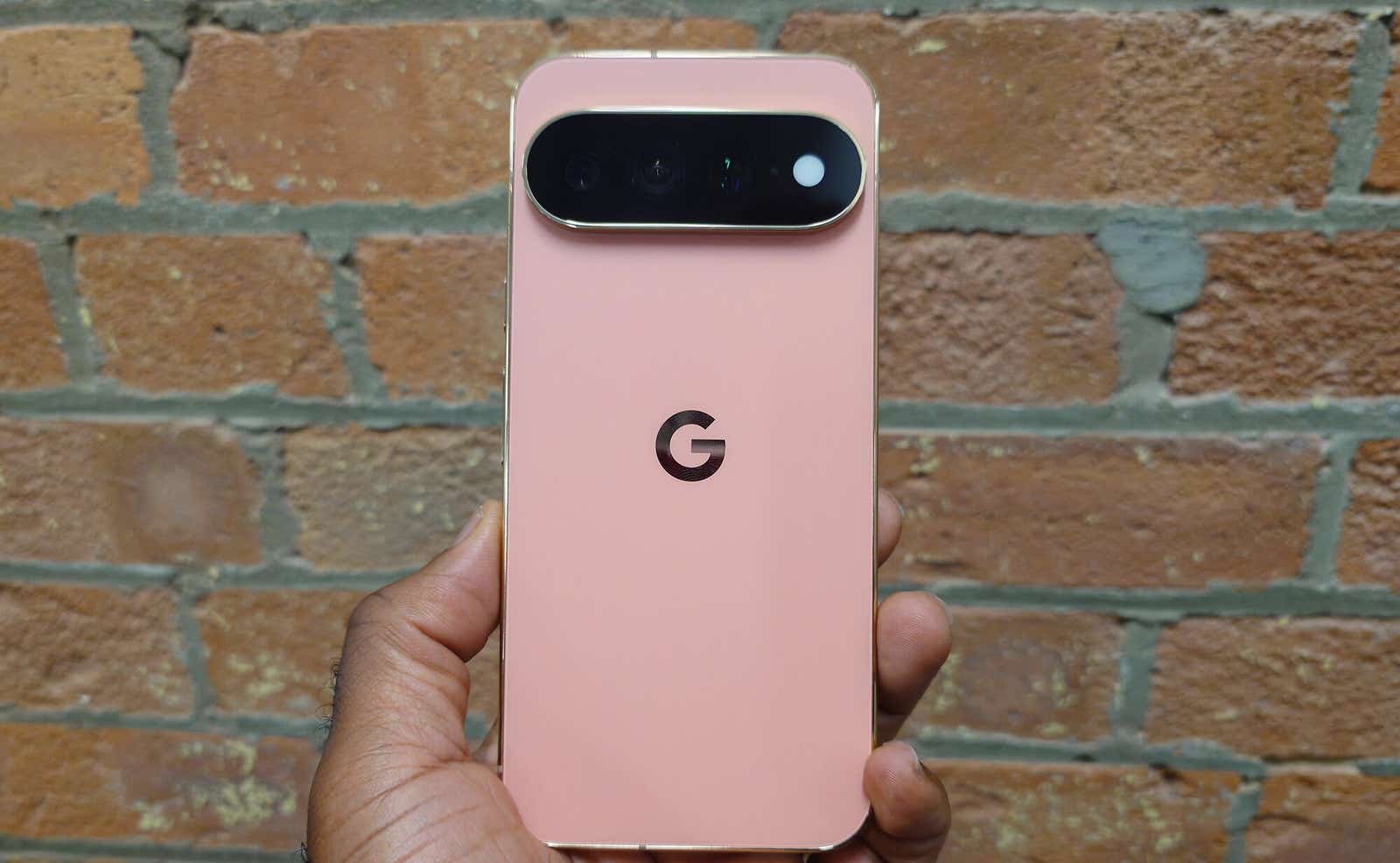
Consumers can choose from four sophisticated colour variants for the Pro XL including Obsidian (Black), Fog (Grey), Olive (Green), and the striking Canyon (Pink).
While we miss the playful naming conventions of Pixels past - the ‘Sorta Seafoam' Pixel 6 and Pixel 4’s ‘Oh So Orange’ remain personal favourites - the bold takes are certainly present on the devices themselves.

We were lent the Canyon model for this review - a lovely shade of matte pink, featuring beautifully ostentatious polished gold metal edges around the frame of the device as well as the camera, and an equally glossy Google logo on the centre of the rear.
While undeniably captivating, this shiny border continues to prove a tad impractical for those who love their smartphones free from cases and looking pristine.
The gorgeous finish can attract fingerprints with ease, making an official Pixelsnap Case or a perpetually handy microfibre cloth highly useful. Thankfully, clear cases are available, ensuring the eye-catching finish doesn’t need to be hidden away entirely.
The combination of an aluminium chassis on the 11 Pro XL and Corning Gorilla Glass Victus 2 on both the 6.8-inch 20:9 display and expansive rear ensures excellent structural integrity, complemented by a robust IP68 certification against dust and water ingress alike.

In a tale of the tape for what makes the Pro Pixels so pro, design and specification differences are immediately apparent.
The standard Pixel 11 pairs a satin aluminium frame with a polished glass rear, while the opposite is the case for both the Pro and Pro XL - all the more easy to spot.
This is firmly the pinnacle of the range, with the Pro XL boasting imposing dimensions of 162.8 mm in height, 76.2 mm in width, and 7.6 mm in depth, weighing in at a substantial 227g.
Internally, the base model of both Pixel ranges offer 12GB of RAM and either 256GB or 512GB of storage, whereas the Pro and XL tier unlocks a 1TB storage option accompanied by a bump up to 16GB of RAM for heavier workloads…read on for why that difference may matter more than most here.
The Google Tensor G6 processor is the brains of the operation, eschewing Qualcomm’s Snapdragon smartphone chips many moons ago for their own custom hardware.

Tucked neatly within the rear camera bar is a subtle new hardware addition named HiLight, a feature entirely exclusive to Google’s Pro models.
A tiny ring of eight LEDs built around the camera flash pulsate with soft visual cues during hands-free interactions when the device is placed face down, indicating when Gemini is actively listening or processing a query - clearly evoking the OS1 device in the classic movie ‘Her’.
Users can also assign custom colours for incoming calls from specific contacts, and…not really much else at the moment.
While the feature brings a charmingly tactile addition to AI functionality, the use of lights to complement hardware interactions are far from new - the Glyphs and rear displays on Nothing’s series of devices are leaps and bounds ahead in terms of both form and function, while its limited application at launch - addressed somewhat by enterprising developers with HiLight Studio - mean this occupies a strictly secondary role to the 11 Pro XL’s industrial design.
Overall, the physical execution of the Pixel 11 Pro XL delivers a reassuringly robust and premium in-hand feel.
The commanding dimensions and the steadfast commitment to the iconic camera bar cement its status as a bold handset, even if playing it so safe feels a little conservative for Google’s flagship device.
Display and audio
The 6.8-inch display here is a serious effort and testament to Google’s approach to hardware, with an OLED panel that stands strong amongst current competition.
Boasting a crisp 1344 x 2992 pixel resolution at 486 PPI alongside a dynamic refresh rate of 120Hz that gracefully descends to 1Hz depending on use, the Pixel 11 Pro XL’s sizeable screen guarantees effortlessly fluid navigation, while protecting all-important battery life.
The display technology itself marks another key upgrade from the base Pixel 11, which utilises a standard OLED panel capped at a 60 to 120Hz variable refresh rate rather than the more power-efficient LTPO technology found on the Pro models.
Luminosity reaches a staggering peak of 3,600 nits - more like 2,400 when viewing HDR content - rendering outdoor visibility completely unhindered even beneath the most glaring midday sun.
On the topic of HDR support, both HDR 10+ for streaming services and Android Ultra HDR for photos and media are catered for, making the most of the real estate for content consumption.

When you do prefer to listen out loud, the device delivers a outstanding acoustic experience.
The handset relies on a highly capable stereo speaker configuration - one at the top and moonlighting as the earpiece, with the other on the bottom edge by the USB-C port - that produces a resoundingly loud and punchy sound profile.
It effortlessly fills a room, presenting remarkably clear vocals alongside a surprising amount of bass, which significantly elevates both content streaming and general media consumption.
Our test tune of Warmpop by George Clanton from the album 100% Electronica - soft vaporwave lilts, enjoying a deserved resurgence thanks to Tiktok - retains all of its warmth and softness on even higher volumes, with the bass remaining crystal clear.
As one might expect, there is no 3.5mm headphone port included on the 11 Pro XL’s chassis, dictating that a USB-C connection or wireless audio options are required for personal listening, with Bluetooth 6.0 complete with Low Energy support available.
Fortunately, when you are in a quieter environment and the wireless connection remains stable, the inclusion of aptX HD aims to ensure that Bluetooth headphones receive pristine audio quality.
However, we found some repeatable connectivity issues which marred the 11 Pro XL’s wireless user experience. Tested over a period of weeks with a pair of Nothing Ear (a), Sonos Ace and OnePlus Buds 4, we found a habit of audio cutting out or desyncing in busy areas.
Walking through a bustling high street or on a busy London Tube with high-resolution audio enabled frequently results in audio dropouts and cacophonous stuttering, with the device catching up with itself after a few seconds - a drawback which we sincerely hope will be ironed out with subsequent updates.
In summary, the combination of blindingly bright, large-scale display technology and immersive stereo acoustics provides an audiovisual experience that comfortably rivals the very best panels currently available on the market.
Check out the latest Sky Mobile SIM-only deals on Uswitch
Camera capabilities

Google's reputation for combining computational photography with robust hardware is one area which remains unblemished, and the Pixel 11 Pro XL’s exhaustive suite of optics largely continues that streak.
The Pro XL’s primary wide module relies on a 50-megapixel sensor - a significant leap over the base Pixel 11, which features a 48-megapixel main sensor.
Alongside it sits a heavily upgraded 48-megapixel ultrawide lens (versus 13-megapixels on the core variant), that incorporates dedicated Macro Focus capabilities.
Long-distance captures are handled by a 48-megapixel periscope telephoto lens with optical stabilisation, 5x optical magnification, and up to 120x with an AI-assisted Pro Zoom mode.
Selfies and video calls are powered by a front-facing 42-megapixel autofocus sensor with an spacious 103-degree field of view.
Crucially, there is no difference between camera capabilities between the Pro and Pro XL models once again throughout, whereas the 11’s 10.5-megapixel front-facing effort is another key point of differentiation to justify the additional outlay.
The entire arrangement is reinforced by all manner of modern conveniences, including multi-zone laser detection autofocus, spectral sensors, and flicker detection.


All of this was rigorously put through its paces in a range of lighting conditions - both a quick daytime jaunt to Google's shiny new London offices in Kings Cross (complete with a cute Pixel takeover) and during a recent Jay-Z concert, where the sheer photographic prowess of the Pixel 11 Pro XL’s hardware became undeniably evident.
Attempting to capture the dynamic stage lighting and rapid movement of a live hip-hop performance often confounds lesser devices.
Yet, the Pixel 11 Pro XL flawlessly balanced the chaotic, strobing illumination, producing pristine, largely noise-free shots of the consummate artist in action.
Attempting to capture the hyper-kinetic energy of K-Pop sensations Katseye (well, 66% of them) at the O2, it was more than a bit of a challenge, although Night Sight came into its own here too.
The images below show that stills of the stage before the chaos were perfect, but combining the low-light scenario with human subjects and 100x zoom was a bit of a stretch...but the 11 Pro XL did well enough to snap the quartet.
Even more impressive was how still a subject at the local park was, a very amenable squirrel - almost invisible in the first shot - stayed still enough for us to zoom into fine textures of fur despite being high up in a tree.
Beyond the challenges of live concert photography, the dedicated still modes have received remarkable enhancements.
Instant Night Sight activates up to 4.5 times faster than on older models, leveraging the enlarged telephoto sensor to snap beautifully lit, astrophotography-grade photos in near-darkness without forcing you to hold perfectly still.
Meanwhile, the High-Res Portrait Mode expertly maps depth of field, applying authentic bokeh while utilising Real Tone and Face Unblur algorithms to ensure subjects remain pin-sharp and true to life with both accuracy and vibrancy.


Moving away from still photography, the device delivers a comprehensive suite of video capture tools. This is another area where the models diverge.
The base Pixel 11 is capped at 4K60 video recording on-device. The Pro XL, conversely, unlocks 8K video recording at 24 or 30 frames per second, powered by Google's cloud-based Video Boost architecture.
The recording options include Night Sight Video, Audio Magic Eraser, 10-bit HDR recording, and Cinematic Pan for smooth tracking shots.
However, operating within these video modes highlighted one area to improve upon - an attempt to switch lenses mid-recording resulted in an occasional visual stutter, breaking the immersion.
To compound matters, the physical implementation of the aforementioned HiLight feature presents a tangible drawback.
To accommodate the internal hardware required for this glowing ring, Google physically altered the flash module. The unfortunate consequence is a noticeable reduction in the overall strength of the LED flash.
When you require raw illumination in a pitch-black environment, this flagship falls short compared to its predecessors, sacrificing core utility for a functionality flourish.
Taking these factors into account, the imaging system represents a staggering achievement in computational photography that excels in challenging still photography scenarios, though the disjointed video zooming and weakened physical flash slightly temper its once absolute dominance.


Check out the latest Google Pixel deals on Uswitch
Performance and software
Boot up the Pixel 11 Pro XL, and it immediately sets an ultra-modern and highly refined tone.
There’s no doubt about what the device is about, with the Google logo giving way to a bespoke Gemini Intelligence logo, marking an immaculate and unfettered Android 17 experience - entirely free from lag or stutter when scrolling or surfing.
Bloatware and ads masquerading as apps found on other devices are entirely absent, replaced by an infinitely customisable interface - I was able to create minimalist pink app icons in seconds directly within the wallpaper menu - and a deeply integrated, proactive assistant designed to fundamentally change how you interact with your device.
The latest AI features integrated throughout Google’s operating system are transformative for daily productivity.
Google's Personal Intelligence now acts as a silent, hyper-efficient digital assistant, appearing - with tact and relevance - throughout.
Magic Cue is the hub of all these contextual smarts, with salient suggestions, handy shortcuts and the device delving into Google’s - and other - apps to make things simply run more seamlessly.
Its Daily Brief feature - note this isn’t available yet in the UK, but is set to arrive in due course - routinely scans your connected Gmail and Workspace apps overnight, greeting users each morning with a perfectly curated summary of impending deadlines, calendar clashes, and outstanding tasks.

Gemini Intelligence also takes that groundbreaking step into agentic functionality - quietly beavering away in the background to automate multi-step tasks via direct app integration.
Long-pressing the power button over a messy grocery list in your notes app will prompt Gemini to automatically open your preferred supermarket application, locate the items, and build a shopping basket ready for checkout.
Similarly, the intelligence engine can scan an airline confirmation email and seamlessly extract a passport photo stored in your Google Photos to fill out a complex flight check-in form without you having to type a single digit.
The new auto-browse function within Chrome takes this a step further, handling mundane web tasks such as reserving parking spaces or updating an online grocery order, only pausing to ask for manual confirmation before sensitive actions like processing a payment.
Once again, results may vary with some of these features being more fully fleshed out than others - we found mixed success with Gemini drawing up a menu of what to cook from a Morrisons order - but it’s an exciting portent of things to come from Google’s AI wizardry so deeply embedded into the operating system.
Phone calls do bring up relevant correspondence to assist too - a cursory call to Octopus Energy to review my bill had an unprompted shortcut to Gmail in the middle of the screen, ensuring that ever-elusive account number was ready to recite when asked - this was a remarkably handy feature and brought to life some of the convenience of Gemini Intelligence.
Tying this all together is a cohesive design language and outstanding haptic feedback tied to the newest search gestures. The subtle, unique vibration when accessing Circle to Search provides exceptional tactile confirmation that makes looking up on-screen information immensely satisfying.
Under the bonnet, the custom Google Tensor G6 chip handles these demanding on-device tasks and multimodal processes with remarkable efficiency. Multitasking between heavy applications happens without a single hesitation, and the slick and intuitive interface is pretty much on par with Apple’s finest when it comes to general navigation and use - high praise indeed.
Yet, this processor does have a significant drawback which bears mentioning, namely decidedly mixed performance from a gaming perspective.
Our gaming test go-to of Infinity Nikki simply refused to work - citing ‘missing cooked content and global shaders’.
Additionally, while popular free-to-play title Genshin Impact eventually loaded after a gruelling 25-minute wait to compile shaders, the gaming experience was more than a little inconsistent.
The title ran acceptably on medium settings, despite a horrible audio bug, but push the graphical sliders anywhere near high and the framerate on the Pixel 11 Pro XL struggled.

Expecting a flagship device to handle mainstream mobile titles is a given, making this faltering performance a notable letdown compared to the competition.
Google has pledged to work with developers to resolve these issues, and it is possible that the larger specced devices with more RAM may operate better, but it yielded disappointing results in general on our review unit - so those looking for gaming on the go should definitely bear this in mind.
Beyond raw processing, the Pixel 11 Pro XL is thankfully fully equipped for the latest wireless communication standards.
The inclusion of Wi-Fi 7 capabilities across tri-band frequencies ensures you can take full advantage of modern ultra-fast routers for exceptionally fast and stable home networking.
For mobile connectivity, the device supports a physical Nano-SIM alongside extensive eSIM compatibility - a boon for fans of roaming data without dealing with fiddly cards, as both a physical and eSIM side by side or dual active eSIMs worked seamlessly.
Overall, the software environment delivers an unparalleled, AI-driven daily interface that is a joy to navigate, provided the user is willing to accept some glaring compromises in gaming horsepower and wireless connectivity stability at present.
Battery life and charging

Powering the 11 Pro XL is a high-capacity 5,115 mAh battery - another plus point for going big when it comes to the Pixel.
The increased efficiency of the Tensor G6 chip ensures this capacity comfortably delivers a full day of heavy usage, even with the exceptionally bright 6.8-inch display continually active, although being paired with the new Pixel Watch 5 did contribute significantly to battery drain, making overnight charging a must to not get caught short.
When looking across the Pixel 11 family, Google has made some interesting decisions regarding battery capacities and charging speeds.
The standard Pixel 11 features a larger 4,985mAh battery than the more expensive Pixel 11 Pro, which houses a smaller 4,850mAh effort, all the more reason why the Pro XL excels above both when it comes to going the distance.
The differences between the Pros themselves come down to sheer capacity and a substantial boost in charging speeds.
The Pro XL not only utilises its larger physical footprint to house the 5,115mAh battery, but also unlocks a 45W extreme wired charging, available to boost speeds primarily when juice is less than 50%.
In real terms, this means compatible chargers - including the 67W Pixel Flex charger in their current promotional offers - can offer a 75% charge in a mere 30 minutes, which is transformational in terms of practicality and closes the daylight on the ridiculous speeds available in Chinese competition from the likes of Oppo and Honor.
Across all three devices, Google has also unified the wireless charging experience with the 11, Pro, and Pro XL all supporting up to 25W Qi2 wireless charging and feature built-in Pixelsnap magnets for accessory attachment with fewer headaches.
To conclude, the integration of robust all-day battery longevity paired with fiercely competitive rapid charging mechanics successfully puts to bed any lingering anxiety associated with previous Pixel iterations when it comes to the 11 Pro XL, it’s certainly the model with the stamina comparable to today’s stable of flagship smartphones.
Google Pixel 11 Pro XL UK pricing and availability

The Pixel 11 Pro XL is available in four colour variants with pricing naturally dictated by storage capacity.
The entry model starts at a hefty £1,279 - an £80 hike on last year’s equivalent price - for 256GB of storage paired with 12GB of RAM. Upgrading to the 512GB tier costs £1,399, while the 1TB edition is £1,549.
Crucially, opting for either the 512GB or 1TB models elevates the system memory to 16GB of RAM and introduces faster Zoned UFS flash storage, catering directly to power users handling substantial 8K video files or intensive on-device processing.
We had the base 256GB model for review, and remain highly interested as to whether the gaming and audio issues could have been stamped out with more horsepower…although this shouldn’t have to be the case at all.
To soften the blow of this premium investment, Google has rolled out an attractive promotional package for early adopters.
Those purchasing directly through the official storefront receive the protective Google Pixelsnap Case, the Pixel Flex Dual Port 67W USB-C Fast Charger, and the magnetic Pixelsnap Charger with Stand at no additional charge.
The obligatory 6 months of access to Google AI Pro, 5TB of cloud storage and Health Premium - a nice tie-in for Pixel Watch 5 fans - are also available, but it's very much a trial after which subscription at a fee of £18.99 begins.
As ever, there were also exceptional trade-in incentives available during the initial launch window, with Google offering trade-in valuations reaching up to £650, bolstered by an additional £200 promotional bonus when handing over eligible older handsets.
These deep discounts have every chance of returning during future seasonal sale events, immediately turning the Pixel series - and the 11 Pro XL in particular - into one of the most compelling value propositions in the premium segment.
In closing, while the entry cost represents a significant financial commitment, the comprehensive storage options, generous bundled accessories, and the very real prospect of lucrative trade-in deals serve to soften that significant sticker price.

Final verdict
The Google Pixel 11 Pro XL is a rollercoaster of brilliant highs and familiar compromises.
The combination of a breathtakingly bright display, industry-leading AI courtesy of Gemini Intelligence, and spectacular photography credentials cements its status as a smartphone showcase.
The tactile joy of Circle to Search and the immaculate Android environment remain pure delights, weeks after use.
However, context is key. When a flagship handset commands upwards of £1,200, one understandably expects an uncompromising hardware experience to match.
Instead, the gaming performance and app compatibility challenges, paired with some teething issues around audio and underdeveloped features in HiLight do bear…highlighting.
If you can offset that initial financial ask with aggressive trade-in allowances and bundled perks, the Pixel 11 Pro XL is an ultra-premium experience in almost all areas, with the savings outweighing any areas needing improvement.
This review unit was generously provided by Sky Mobile, who offer a multiple ways to grab the new Google Pixel 11 series of devices, including spreading the cost with their Swap plans.
Sky more than doubled its global roaming destinations from 55 to 120 across EU/EEA, the USA, Australia and more.
Sky’s Roaming Passport Plus enables customers use their data, calls and text allowances as if they were still in the UK for just £2 a day.
Not content with stopping there, Sky has also introduced free global roaming in 120 destinations for its most loyal customers, through Sky VIP.
Sky's VIP Diamond customers (those who’ve been with Sky for over 15 years) can use their Sky Mobile data, calls and text allowances abroad all over the world, just as they would in the UK, at no extra cost.
The new VIP benefit applies to any Sky VIP Diamond customer either currently with, or newly joining Sky Mobile, and works with all data plans.
Sky Mobile network benefits also include:
Roll – roll your spare data for up to a year into your Sky Piggybank for use when you need it
Piggybank – share spare data in your Sky Piggybank with up to seven SIMs on your account or exchange it for rewards
Mix – choose to change your data plan whenever you like
Watch – enjoy hours and hours of streaming on Sky apps such as Sky Go, Sky Sports and more, without using your data allowance
All this on a network offering 99% 4G UK population network coverage - certainly one to consider when buying a new mobile phone!
