- Uswitch.com>
- Mortgages>
- What are the current UK mortgage rates today? | 27 February 2026
Mortgage Rates Today
UK mortgage interest rates can change quickly at the moment, depending on the current cost of swap rates, Bank of England (BoE) base rate announcements, and lenders' discretion.
In this article, we break down the current average mortgage rates in the UK and look at the potential direction of future UK mortgage rates.
And if you're ready for a mortgage, our broker partner Mojo can help you find your best deal.
Latest mortgage rates
We reveal the average mortgage rates in the UK for residential and buy-to-let mortgage deals below. These can be useful as a measure of what's happening in the mortgage market, but aren't necessarily indicative of the mortgage deal you could get.
Current residential mortgage rates
A residential mortgage is one that you use for a property you plan to live in. The table below shows the average rates for selected deal lengths and types.
| Deal type and length | Average rate across all lenders | Average rate across big six lenders |
|---|---|---|
| 2 year fixed-rate (75% LTV) | 4.53% | 3.94% |
| 5 year fixed-rate (75% LTV) | 4.96% | 4.04% |
| 2 year variable rate (75% LTV) | 4.25% | 4.18% |
| Standard variable rate (SVR) | 7.45% | 6.49% |
All average rates are provided by Mojo Mortgages. The above are the average mortgage rates for various products across the market. These won't necessarily be available to you, and are not the only product types available.
Current buy-to-let mortgage rates
A buy-to-let mortgage is usually used to purchase a property that you plan to rent out to others. The below table shows the average buy-to-let mortgage rates for selected deal lengths and types.
| Deal type and length | Average rate across all lenders | Average rate across big six lenders |
|---|---|---|
| 2 year fixed-rate mortgage (75% LTV) | 5.00% | 4.22% |
All average rates provided by Mojo Mortgages. The above are the average mortgage rates for a two-year fixed-rate (75% LTV) buy-to-let mortgage. These won't necessarily be available to you, and are not the only product types available.
The above tables display the average mortgage rates across residential and buy-to-let mortgage deals in the UK. While these can be useful for mortgage rate comparison and as a measure of what's happening in the UK mortgage market, keep in mind that they are average mortgage rates.
It's important to note the above rates aren't necessarily indicative of the full range of mortgage deals available in 2025 or of the lowest mortgage rates that you may be offered.
The lowest mortgage rate you can get will depend on your personal and financial circumstances and how much deposit you can put down. The bigger the deposit, the lower the loan-to-value (LTV) which generally allows you access to better mortgage rates - as lenders will see you as less risky.
In the current climate, it's worth speaking to a whole-of-market mortgage broker who can compare mortgages to find the right current mortgage rate for you.
Best current mortgage rates
The table below shows some of the best two year fixed-rate mortgages and five year fixed-rate mortgages in the market today. These might not suit you and your circumstances, but our partner Mojo can help you find deals that do.

- 2 years
- Fixed rate
- Monthly repayment£ 847.52
- Loan to value60 %
- Initial interest rate3.58 %
- Variable rate6.24 %
- APRC6%
- Product fees£ 1,016
Representative example:Repayment mortgage of £168,000.00 over 25 years, representative APRC 6%. Repayments: 27 months of £847.52 at 3.58% (fixed), then 273 months of £1,085.32 at 6.24% (variable). Total amount payable £319,175.40. Early repayment charges apply until 31-May-2028. Arrangement, mortgage discharge, valuation and CHAPS fees total £1016. Legal fees £295.

- 2 years
- Fixed rate
- Monthly repayment£ 1,001.31
- Loan to value70 %
- Initial interest rate3.69 %
- Variable rate6.49 %
- APRC6.2%
- Product fees£ 1,014
Representative example:Repayment mortgage of £196,000.00 over 25 years, representative APRC 6.2%. Repayments: 24 months of £1,001.31 at 3.69% (fixed), then 276 months of £1,299.73 at 6.49% (variable). Total amount payable £382,756.92. Early repayment charges apply until 2 years. Arrangement, mortgage discharge, valuation and CHAPS fees total £1014.

- 2 years
- Fixed rate
- Monthly repayment£ 1,154.09
- Loan to value80 %
- Initial interest rate3.77 %
- Variable rate5.74 %
- APRC5.6%
- Product fees£ 1,004
Representative example:Repayment mortgage of £224,000.00 over 25 years, representative APRC 5.6%. Repayments: 28 months of £1,154.09 at 3.77% (fixed), then 272 months of £1,387.40 at 5.74% (variable). Total amount payable £409,687.32. Early repayment charges apply until 30-Jun-2028. Arrangement, mortgage discharge, valuation and CHAPS fees total £1004. Legal fees £126.

- 2 years
- Fixed rate
- Monthly repayment£ 1,328.76
- Loan to value90 %
- Initial interest rate3.99 %
- Variable rate6.94 %
- APRC6.6%
- Product fees£ 1,705
Representative example:Repayment mortgage of £252,000.00 over 25 years, representative APRC 6.6%. Repayments: 26 months of £1,328.76 at 3.99% (fixed), then 274 months of £1,738.50 at 6.94% (variable). Total amount payable £510,896.76. Early repayment charges apply until 30-Apr-2028. Arrangement, mortgage discharge, valuation and CHAPS fees total £1705. Legal fees £258.
The above deals are provided by Mojo Mortgages and updated every 12 hours. They may not be suitable for your circumstances and might not be available when you're ready to submit an application. Remember, you could lose your home if you don't keep up with your mortgage repayments.
Why are mortgage rates so high?
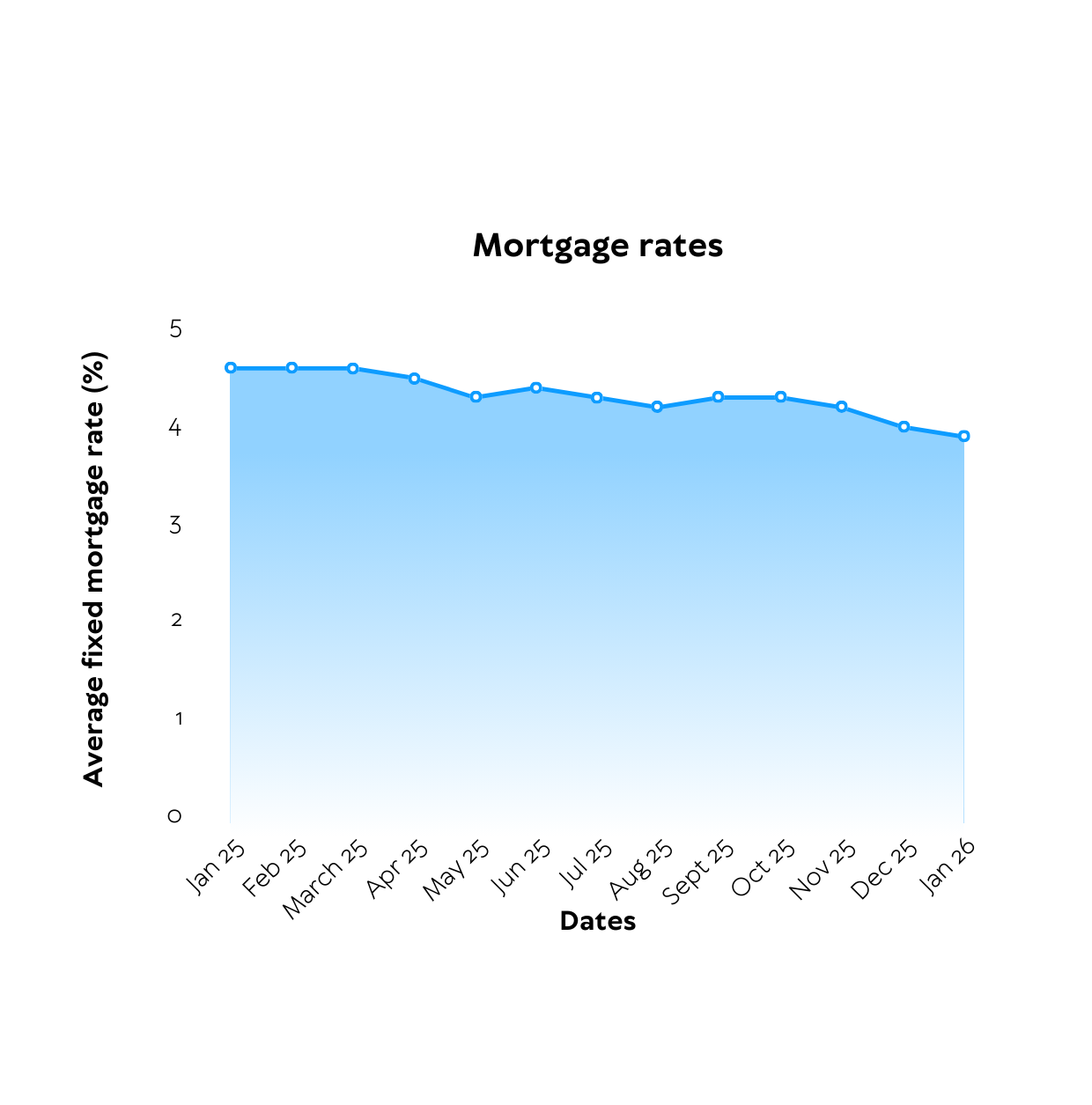
The average fixed mortgage rates declined steadily throughout 2024 and into early 2025, and experts expect this trend to continue over 2026 - particularly if the Bank of England base rate falls further. However, lots of other factors determine current mortgage rate trends, so it's wise to compare rates regularly if you plan to take on a new deal.
From the end of 2021 until August 2023, the Bank of England increased the base rate 14 times in a row to 5.25% in order to combat rising inflation. The UK's inflation rate dropped under the Bank of England's 2% target in September 2024. This prompted a base rate cut to 4.75% in November 2024, which was followed by three further reductions throughout 2025, with further cuts expected throughout 2026. Currently, inflation sits at 3.4%.
It’s hard to know exactly what the market will do, but we’ll keep you up to date with the latest Bank of England updates and mortgage rate changes.
On 5 February 2026, the Bank of England announced it will hold the base rate at 3.75%.
Will mortgage rates rise or fall in 2026?
Many factors influence how lenders determine mortgage rates, with the base rate and swap rates being major considerations. However, even the most skilled financial analysts can only venture an educated guess of when mortgage rates are likely to fall across the board.
Swap rates changed a lot in the last year, which meant there was continued volatility in the market despite the base rate remaining the same for much of 2024. However, in early 2025, swap rates began to fall which prompted some lenders to start to reduce their mortgage rates.
While changes to the base rate don't necessarily mean that mortgage rates will also change, certain mortgage deals (tracker mortgages) do have rates directly linked to the base rate so it's a good idea to keep an eye on upcoming announcements. The current base rate is 3.75% and the Bank of England's Monetary Policy Committee is next set to make a decision about whether to increase or decrease the base rate on 19 March 2026.
If you are due to remortgage, the average standard variable rate (which you're moved to after your current mortgage deal ends) is just below 8%, which is much higher than the average fixed mortgage rate.
The below graph shows how fixed mortgage rates changed over the course of 2024 and into 2025 due to various factors. However, the best way to stay up to date with current average rates is to sign up to our newsletter, and always make sure you speak to a mortgage broker who can help you find the best mortgage deals available.
Source: Mojo Mortgages
Loan-to-value (LTV) is the amount you borrow for a mortgage as a percentage of the total value of the property
What should I do if mortgage rates rise?
If you're concerned about your mortgage interest rate rising, then you may want to consider:
Fixing your mortgage – this will keep your rate the same for a set period of time. If your current mortgage deal hasn't ended, however, make sure you're aware of any early repayment charges (ERCs) when you compare mortgage rates
Secure a new interest rate today – if you're due to remortgage within the next six months, you can lock in a new rate now and switch when your mortgage deal ends, avoiding an ERC. If rates fall before your deal ends, you can switch again to get a better option
What should I do if mortgage rates fall?
if you're worried that interest rates will fall after you've secured a mortgage, you could:
Opt for a shorter-term fixed-rate mortgage deal – this means you're locked into that rate for less time
Consider a variable-rate mortgage, such as a discount deal – but keep in mind that if rates rise, you'll end up with higher monthly repayments
Customers also asked
How do mortgage rates work?
When you take out a mortgage, you're taking out a loan which you'll need to repay. In addition to the loan, you have to pay interest on the amount you borrowed.
The amount of interest you pay is determined by your mortgage rate. The higher this is, the more expensive your monthly repayments will be. That's why it's good to try and get a deal with as low a mortgage interest rate as possible
What is a good mortgage interest rate?
A good mortgage interest rate depends on market conditions, along with the size of your deposit and financial circumstances. If you have a large deposit (ideally 40% or more) and excellent credit history, you should be able to get some of the lowest mortgage rates available. However, if have a small deposit and your credit rating isn't so strong, you'll likely find you have to pay a more expensive mortgage rate.
This is because lenders tend to base the rate on how much risk they're taking on by letting you borrow from them. The higher the deposit you put down, the lower the LTV ratio and less risk they're taking on. Similarly, if you have a great credit history, lenders are likely to see you as less of a risk. A mortgage broker can help you find the the most suitable mortgage rate for your circumstances.
Should I lock in a mortgage rate today?
It really depends on your circumstances. If you're already on, or about to fall onto a high SVR (standard variable rate), then you'll need to consider whether it's worth paying more interest while you wait to see whether rates fall further.
However, keep in mind that the market has seen significant volatility in recent years, and just because rates have fallen from their highest levels in recent history, the base rate remains high for the time being.
If you plan to move soon, then it may be worth staying on an SVR for a short time, as there are no ERCs to pay when you do look at a new mortgage deal. However, it's a good idea to take guidance from a broker on your mortgage comparison if you're uncertain on your best move.
Can you lock in a mortgage rate for 30 years?
It is possible to find 30 year, and even some longer fixed-rate mortgage deals than that in the UK these days. But this is typically far more common in the USA and Europe, as our longer-term fixed rate deals still tend to be fairly pricey, and hard to find.
However, there are multiple pros and cons to consider when it comes to locking in a mortgage deal for a very long time. It's a good idea to look at whether a long term fixed-rate mortgage is the right option for you, before tying in for 30 years.
Should I buy a house in 2026?
If you're buying your first home, one of the most important factors is your personal financial circumstances. So while the market conditions, in terms of mortgage rates and house prices should also be a factor, it's a good idea to ensure you have a good deposit, and strong affordability regardless.
You can monitor house prices via Zoopla's monthly house price index, and keep up with what's going on in the UK mortgage world on our mortgage news page. However, ultimately, even in a peak buyers market, ensure you're in the best personal position too.
Why do mortgage rates change?
There are several factors that impact mortgage rates changing, which include:
The Bank of England base rate Mortgage rates fluctuate based on many factors, with main ones being the Bank of England’s base rate, which serves as a benchmark for how much lenders charge to loan money.
Inflation The government adjusts the Bank of England base rate to manage inflation. They raise it to slow down spending or lower it to stimulate growth, and mortgages tend to follow suit.
Swap rates Fixed-rate mortgage deals are closely tied to swap rates, which are the interest rates that banks charge each other for borrowing. When swap rates rise, it typically becomes more expensive for mortgage lenders to borrow, causing lenders to reprice their fixed-rate mortgage deals.
Perceived risk If the economy looks shaky, mortgage lenders may raise rates to cover the risk of people defaulting on their loan.
What happens if my mortgage rate changes?
If you’re in a fixed-rate mortgage, your mortgage rate won’t change for the entire length of the term. You’ll only face the change when your fixed term ends.
If you’re on a standard variable rate mortgage, lenders can change the rate whenever they want. It usually follows the base rate, but SVRs can be high, so even if rates drop slightly, you still may be paying more than you need to.
For those with a tracker mortgage, your interest is directly linked to the Bank of England base rate. When it changes, your monthly payments will change, most likely within the following month.
Will 'Dutch-style' mortgages come to the UK?
Dutch-style mortgages are named as such based on similar mortgage products on the continent. The difference is that they provide longer fixed-term deals with interest rates that decline automatically as you pay the mortgage off.
This is intended to save time and money by reducing the need to regularly remortgage at the end of a fixed term. Not many UK lenders currently offer this type of product, however, if popular, there is always the potential that others will follow suit.
Can I get a 99% mortgage?
The government were looking into the potential to offer a 99% mortgage scheme at the beginning of 2024, and while there is no official stance on this at the time of writing, the FCA suggests that this idea has since been scrapped by the chancellor.
There is currently one lender offering an effectively 99% mortgage, in that they accept £5000 deposit to purchase a property 'up to' the value of £500,000. There is also one 100% mortgage product on the market.
However, it's important to fully understand the risks involved with taking out a low or zero deposit mortgage.
When will mortgage rates go down?
One of the most commonly asked question relating to mortgage rates is when they will come down. However, while average rates are often quoted in the press, it's important to understand that every lender sets their rates based upon their own best guesses. This is why in the same week we can see some lenders push their rates up and others cut them.
There are many factors that come into play when lenders determine mortgage rates, with the base rate and swap rates being major considerations. However, ultimately, even the most skilled financial analysts can only venture an educated guess of when mortgage rates are likely to fall across the board.
The best way to stay up to date with current average rates is to bookmark this page, and always ensure you speak to a mortgage broker who can help you find the best mortgage deals available.
How does the Bank of England Base Rate impact mortgage rates?
The Bank of England base rate is used by the organisation to help manage inflation. When inflation is low and they want to encourage borrowing and spending, the Bank of England will lower the base rate, as this make loans more affordable.
When they want to reduce inflation, the Bank of England will increase the base rate. The idea is that this will discourage spending and encourage saving. With mortgages, it depends on what kind of deal you have as to how base rate changes will affect your rate.
You can find out more in our guide to the Bank of England base rate.

Didn’t find what you were looking for?
Find out about other mortgages
Read some of our most popular guides
About the author

YOUR HOME/PROPERTY MAY BE REPOSSESSED IF YOU DO NOT KEEP UP WITH YOUR MORTGAGE REPAYMENTS.
The FCA does not regulate mortgages on commercial or investment buy-to-let properties.
Uswitch makes introductions to Mojo Mortgages to provide mortgage solutions.
Uswitch and Mojo Mortgages are part of the same group of companies. Uswitch Limited is authorised and regulated by the Financial Conduct Authority (FCA) under firm reference number 312850. You can check this on the Financial Services Register by visiting the FCA website.
Uswitch Limited is registered in England and Wales (Company No 03612689) The Cooperage, 5 Copper Row, London SE1 2LH.
Mojo Mortgages is a trading style of Life's Great Limited which is registered in England and Wales (06246376). Mojo are authorised and regulated by the Financial Conduct Authority and are on the Financial Services Register (478215)
Mojo’s registered office is The Cooperage, 5 Copper Row, London, SE1 2LH. To contact Mojo by phone, please call 0333 123 0012.